
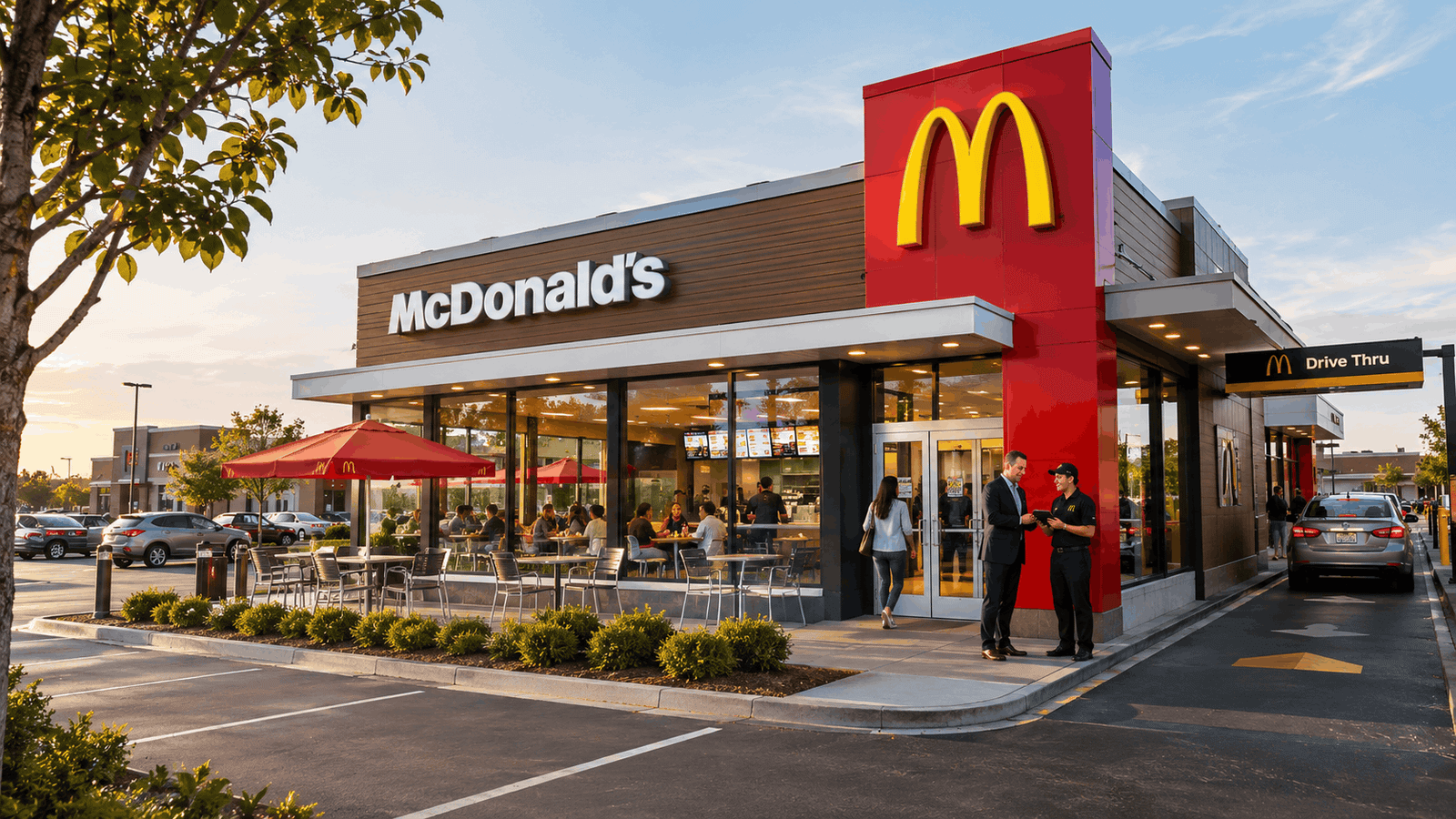
When you walk into a McDonald’s restaurant, you probably think about burgers, fries, and quick service. But behind those familiar golden arches is a business model that has helped McDonald’s become one of the world’s largest restaurant chains.
What makes McDonald’s particularly interesting is that the company does not directly operate most of its restaurants. Instead, independent business owners run the majority of locations under franchise agreements.
According to McDonald’s 2025 Annual Report, approximately 95% of its restaurants worldwide were franchised at the end of 2025.
This raises an interesting question: How does McDonald’s make money when other people operate most of its restaurants?
The answer involves a carefully structured combination of franchising, real estate, brand recognition, and ongoing payments from restaurant operators.
Let’s explore how the McDonald’s franchise business model works, who pays for what, and why this approach has been so successful.
Understanding the McDonald’s Franchise Business Model
A franchise is a business arrangement in which one company allows an independent business owner to operate under its established brand, systems, and standards.
In McDonald’s case, the company providing the franchise is called the franchisor, while the independent business owner operating the restaurant is called the franchisee.
The franchisee receives permission to operate a McDonald’s restaurant, use its trademarks, and follow its established operating system.
In exchange, the franchisee invests money into the business, manages restaurant operations, and makes payments to McDonald’s according to the franchise agreement.
What Does McDonald’s Provide?
McDonald’s provides franchisees with access to an established business system rather than requiring them to create a restaurant brand from scratch.
- Brand recognition: Customers already recognize the McDonald’s name and products.
- Operating systems: Standardized procedures help restaurants maintain consistent service and food quality.
- Training: Franchisees receive training in restaurant management and business operations.
- Marketing support: Restaurants benefit from national and international brand advertising.
- Supply chain access: Approved suppliers and purchasing systems support restaurant operations.
- Technology: Franchisees use restaurant systems and digital platforms supported by McDonald’s.
However, these advantages come with responsibilities. Franchisees must follow McDonald’s operating standards and meet contractual requirements.
How Does McDonald’s Make Money From Franchises?
McDonald’s earns revenue through several sources, but franchising is especially important because it allows the company to collect payments from independently operated restaurants.
1. Initial Franchise Fees
When an approved operator enters a franchise agreement, an initial franchise fee may be required.
This payment is associated with obtaining the right to operate under the McDonald’s brand and business system.
The applicable fee depends on the market, agreement, and type of franchise arrangement.
2. Ongoing Royalties
Franchisees also pay ongoing royalties, generally calculated as a percentage of restaurant sales.
This is an important distinction because royalties are typically based on sales rather than the franchisee’s remaining profit.
For example, if a restaurant generates $100,000 in monthly sales and its hypothetical royalty rate is 4%, the royalty payment would equal $4,000.
This is only an illustration, not a statement of the royalty rate applicable to every McDonald’s franchise.
Actual rates and payment arrangements depend on the relevant franchise agreement.
3. Rent and Property-Related Payments
Real estate is another important part of the McDonald’s business model.
Under conventional franchise arrangements, McDonald’s generally controls the restaurant property through ownership or a long-term lease.
The franchisee then pays rent to McDonald’s as part of the arrangement.
Rent may include a minimum payment, a percentage of restaurant sales, or a combination of contractual arrangements.
This structure allows McDonald’s to generate revenue through both restaurant-related royalties and property-related payments.
However, not every McDonald’s restaurant follows this exact arrangement. In some international markets, developmental licensees provide the capital and real estate needed to operate and expand the business.
Who Owns the Building and Land?
One of the most interesting aspects of McDonald’s is its relationship with commercial real estate.
In many conventional franchise arrangements, McDonald’s controls the restaurant location while the franchisee owns and operates the restaurant business.
This distinction helps explain why McDonald’s is sometimes described as having both a restaurant business and a substantial real estate component.
Location selection is particularly important for fast-food restaurants because accessibility, visibility, traffic, and surrounding customer demand can influence sales.
By maintaining control over many restaurant properties, McDonald’s can also influence how those locations are developed and used.
Still, McDonald’s is not simply a real estate company. Its business depends on restaurant performance, franchise relationships, and customer demand.
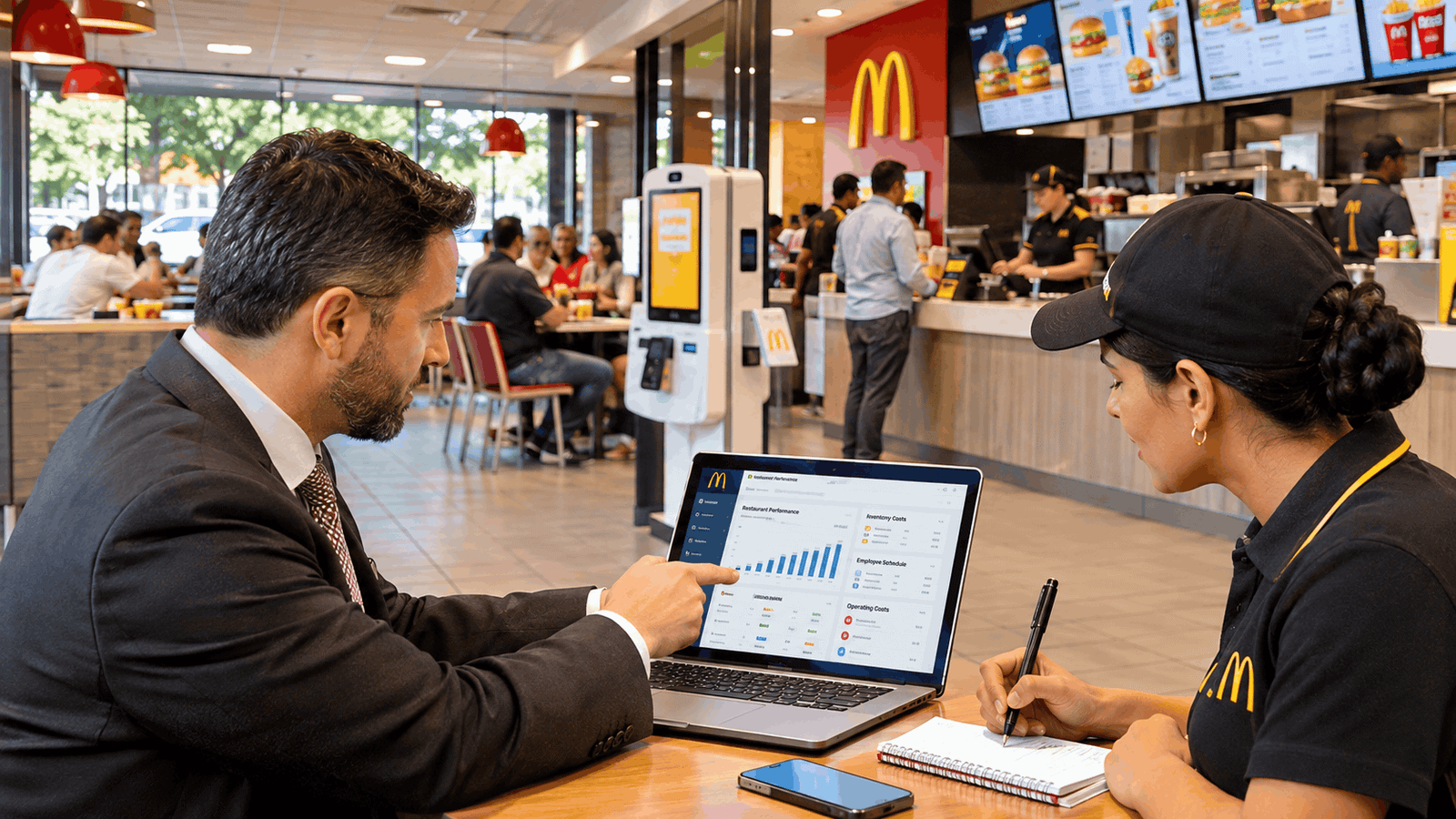
How Much Does It Cost to Open a McDonald’s Franchise?
Opening or purchasing a McDonald’s franchise requires significant financial resources.
The amount varies depending on the country, restaurant location, whether the restaurant already exists, and the terms of the transaction.
For prospective franchisees in the United States, McDonald’s currently states that candidates typically need at least $750,000 in non-borrowed, unencumbered personal funds.
The company also recommends at least $100,000 in working capital per restaurant and an additional $75,000 for potential relocation expenses.
These amounts are financial qualification requirements and recommendations, not the complete purchase price of a McDonald’s restaurant.
What Expenses Should Franchisees Expect?
Depending on the arrangement, franchise-related expenses may include:
- Restaurant acquisition or development costs.
- Initial franchise fees.
- Equipment, furniture, and restaurant improvements.
- Inventory and operating supplies.
- Employee wages and training expenses.
- Rent, royalties, and other contractual payments.
- Insurance, utilities, maintenance, and other operating expenses.
- Working capital for ongoing restaurant operations.
Because requirements differ internationally, aspiring franchisees should review the official financial conditions for their specific country.
They should also distinguish between the total investment required and the amount of personal funds needed to qualify.
How Does a McDonald’s Franchisee Make a Profit?
Although franchisees benefit from operating under a recognized brand, they still need to manage the financial performance of their restaurants.
Customers pay the restaurant for food and beverages. The franchisee uses that revenue to cover operating costs and contractual payments.
Whatever remains after expenses, financing costs, and other applicable obligations determines the business’s financial return.
A Simple Example of Restaurant Profit
Imagine a hypothetical McDonald’s franchise generating $150,000 in monthly sales.
Its simplified monthly financial picture might look like this:
| Financial Item | Monthly Amount |
|---|---|
| Total restaurant sales | $150,000 |
| Food, packaging, and supplies | $45,000 |
| Employee wages and related costs | $40,000 |
| Rent and occupancy costs | $15,000 |
| Royalties and marketing contributions | $12,000 |
| Utilities, maintenance, and other operating costs | $23,000 |
| Illustrative operating profit | $15,000 |
Important: These figures are entirely hypothetical and are provided only to explain how restaurant finances work. They do not represent actual McDonald’s franchise performance, fees, or average profitability. Financing costs, taxes, depreciation, and other expenses may further affect the owner’s final return.
The example demonstrates that strong restaurant sales do not automatically translate into equally strong profits.
Food costs, labor expenses, rent, debt payments, and operational efficiency all influence profitability.
Why Does McDonald’s Prefer Franchising?
Franchising allows McDonald’s to expand its restaurant network while sharing the responsibilities and financial commitments of operating restaurants with independent business owners.
Expansion Without Directly Operating Every Restaurant
If McDonald’s operated every restaurant itself, it would need to manage the employees, daily expenses, and operational responsibilities of every location directly.
Franchising allows independent operators to take responsibility for much of that work.
The company can therefore focus significant resources on brand development, technology, marketing, operational systems, and supporting its restaurant network.
Local Business Knowledge
Local franchisees often understand their communities, customer preferences, and labor markets.
This local knowledge can be valuable when operating restaurants across countries with different cultures and consumer habits.
McDonald’s combines internationally recognized brand standards with selected local adaptations, including market-specific menu offerings.
Recurring Revenue
Royalties and other recurring franchise payments provide McDonald’s with revenue linked to restaurant sales.
However, this income is not completely risk-free or guaranteed. Restaurant closures, weak sales, economic conditions, and franchisee difficulties can affect the business.
How Do You Become a McDonald’s Franchise Owner?
Buying a McDonald’s franchise is not as simple as paying a fee and opening a restaurant.
McDonald’s evaluates candidates based on their finances, business experience, management abilities, and willingness to follow its operating standards.
In the United States, the general process includes:
- Submit an inquiry: Express interest through McDonald’s official franchising application process.
- Complete the evaluation: Provide information about professional experience, finances, and business qualifications.
- Attend interviews: Qualified applicants participate in interviews and further assessment.
- Complete training: Accepted candidates undertake practical and classroom-based restaurant management training.
- Review available opportunities: McDonald’s discusses potential restaurant purchases with candidates who successfully complete training.
- Finalize the purchase: Approved candidates complete the necessary agreements and become restaurant operators.
McDonald’s states that its U.S. training program generally takes approximately six to twelve months.
Completing training does not guarantee that a suitable restaurant will immediately become available.
International application processes may differ because franchise arrangements and candidate selection are managed according to individual markets.
Advantages and Challenges of Owning a McDonald’s Franchise
Franchising offers certain advantages compared with launching an entirely independent restaurant, but it also introduces obligations that business owners should understand.
Potential Advantages
- Access to an internationally recognized restaurant brand.
- Established operating procedures and training.
- Support from a large restaurant and supplier network.
- Existing customer awareness of the brand.
- Potential opportunities to operate additional restaurants.
Important Challenges
- Substantial financial resources are required.
- Franchisees have limited freedom to change core products or operating standards.
- Ongoing royalties and rent affect restaurant profitability.
- Labor shortages, food costs, and competition create operational risks.
- Restaurant ownership requires active management and continuing investment.
Brand recognition can help attract customers, but it does not eliminate the financial and operational risks of running a restaurant.
General Curiosity
Does McDonald’s Own Every Restaurant?
No. Most McDonald’s restaurants are operated by independent franchisees. The company also operates some restaurants directly, while other locations follow international licensing arrangements.
Can Anyone Buy a McDonald’s Franchise?
No. Applicants must satisfy financial and operational requirements and pass the company’s selection process. Having enough money alone does not guarantee approval.
Can a McDonald’s Franchise Owner Change the Menu?
Franchisees generally cannot independently change the core menu or operating system. However, McDonald’s offers market-specific menu items in different countries through approved local and corporate arrangements.
Is McDonald’s a Real Estate Business or a Restaurant Business?
It has important elements of both. McDonald’s is primarily a global restaurant business, but its conventional franchising model also generates revenue from restaurant property arrangements.
Can Someone Own Multiple McDonald’s Restaurants?
Yes. Some approved franchisees operate multiple restaurants. However, expansion depends on financial qualifications, operational performance, market opportunities, and approval from McDonald’s.
Conclusion
The McDonald’s franchise business model works by combining the resources of a global company with the investment and management efforts of independent business owners.
Franchisees operate restaurants and generate sales, while McDonald’s earns revenue through royalties, rent, initial fees, and other applicable arrangements.
This approach has allowed the company to build an extensive international restaurant network without directly operating every location.
For aspiring entrepreneurs, the biggest lesson is that a recognizable brand and an established business system can provide valuable advantages, but long-term success still depends on financial discipline, customer service, and effective operations.
Anyone considering a McDonald’s franchise should carefully review the official requirements, franchise disclosures, and financial risks before committing to an investment.